Foothill #285 and a History of Transit Service on Whittier Blvd.

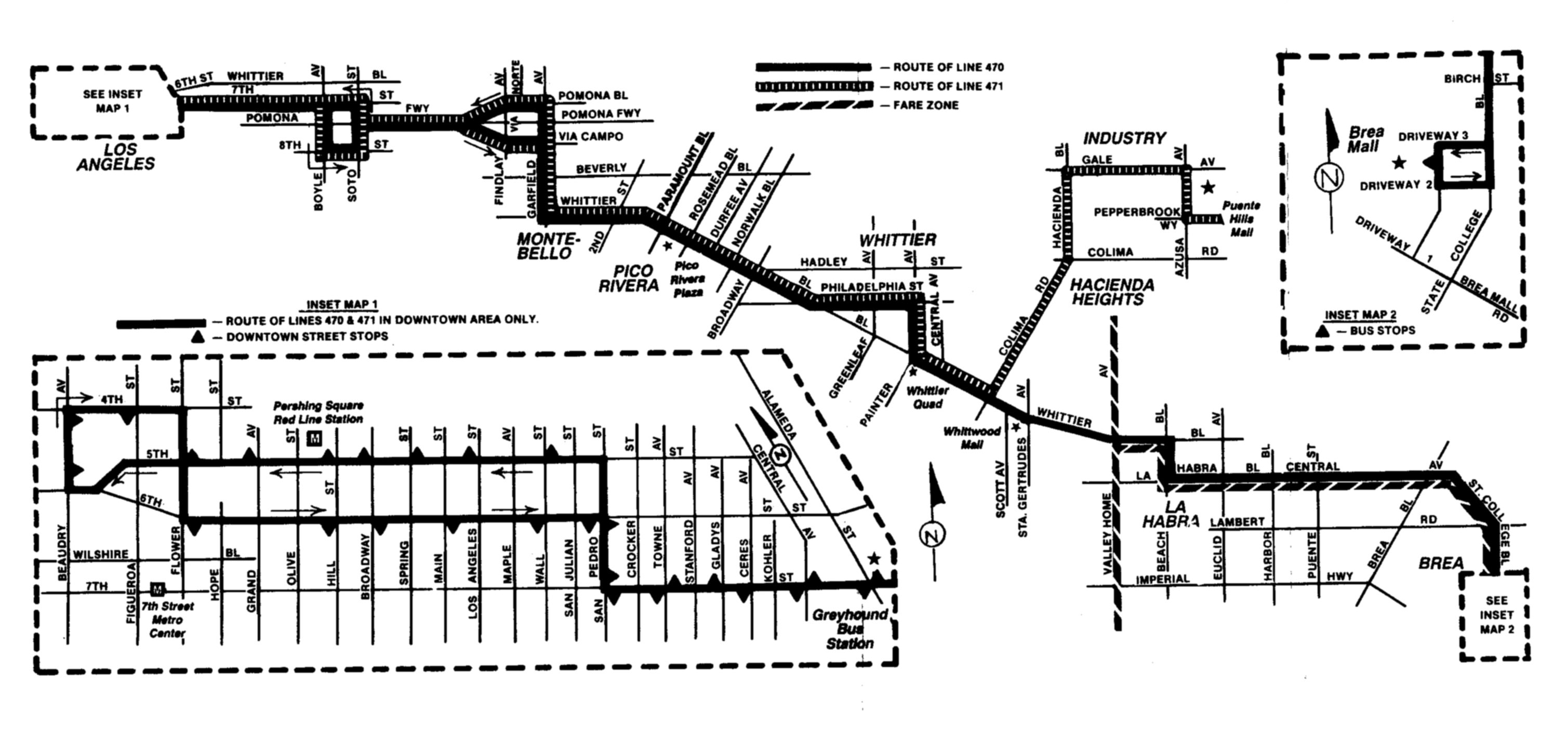
Map of RTD 470/471, December 1994

Map of RTD 470/471, December 1994

Due to the lack of state funding, Foothill Transit may cancel its Route #285, between La Puente and La Habra via Whittier. If #285 is cancelled, and if no other transit agency steps in to replace it, the two-mile stretch of Whitter Bl. between Whitwood Mall and the county line at Beach Bl will be left without transit service.

As I looked at Foothill’s proposal, I thought about the long and interesting history of transit service along the Whittier Bl. corridor.

Streetcar service on what was then called Stephenson Street started in 1903, between Boyle Ave. and Indiana St. This service was extended into downtown Los Angeles in 1910, when the 7th Street bridge over the Los Angeles River opened. Los Angeles Railway through-routed the Whittier Bl streetcar with the West 3rd Street car line, and designated Route “R.” This route lasted through the Los Angeles Transit Lines era (1945-1958)/ The Los Angeles Metropolitan Transit Authority (LAMTA) kept the streetcar going until 1963, when it was converted into a bus route and numbered #28.

Route “R” and #28 provided local service within a few miles of downtown. Buses (also known as “stages”—as in stagecoach) served longer distance trips along Whittier Bl from the mid-1910s.

A variety of bus companies, using modified cars and trucks of all descriptions, fanned out from downtown Los Angeles in those days. Many of these outfits were not particularly well-run businesses, and ended up going bankrupt, or taken over by stronger companies.

P&E Stage Line (the name meant “Package and Express”) was an early bus company that ran along Whittier Boulevard from Los Angeles to Fullerton. After a bad year in 1916, P&E sold its buses back to the dealer and went out of business.

The dealer,  Mr. O.R. Fuller, decided to try his hand at the bus business, and reactivated the Whittier Bl. route in early 1917. Fuller was apparently successful at this new venture; by 1924, his bus system, named “Motor Transit” was the largest bus system in California. Motor Transit operated all over Southern California: east to Riverside, San Bernardino and the mountains; south through Orange County to San Diego; and north via the Ridge Route to Bakersfield.

Motor Transit’s Whittier line left downtown Los Angeles from a depot at 5th and Los Angeles Streets, then headed east along Whittier Bl. Since the streetcar also ran along Whittier, Motor Transit was not allowed to provide local service along Whittier until the end of the streetcar line. The first unrestricted stop was at Indiana St. (This restriction remained in place, under Pacific Electric, Metropolitan Coach, LAMTA and RTD operation, until early 1976!)

Going eastward, Motor Transit served the communities along Whittier Bl, such as Montebello, Pico (now Pico Rivera), and “Guadalupe Hidalgo” (aka Jimtown). The route left Whittier Bl to serve central Whittier, then returned to the boulevard, serving East Whittier, crossing into Orange County, through Des Moines (now La Habra), Stewart (now part of Brea), Brea and Fullerton before the final stop in Anaheim. Passengers could continue southward as far as San Diego on certain trips as well.

These were the days before freeways and suburban sprawl; riders on these buses saw little but fields and orchards between the towns. Motor Transit made good time on the (mostly?) two-lane roads; the trip from Los Angeles to Anaheim took about an hour and a half.

Fuller sold Motor Transit to the Greyhound Bus Corporation in 1929. Greyhound took over Motor Transit’s long distance routes (e.g. San Diego, Bakersfield, Victorville), leaving Motor Transit as a suburban bus system. Pacific Electric later bought Motor Transit and replaced certain underperforming rail lines with bus routes. Pacific Electric also decided to number its bus routes in 1943; all of the bus routes operating between Los Angeles and Santa Ana, were called Route #58. The Whittier Bl. route was designated #58W.

In 1966, the Southern California Rapid Transit District (RTD) renumbered Route #58 to #72. The new number was not only much less confusing, but also more appropriate as Whittier Blvd had been designated California State Highway 72 in 1963.

Big changes came to Whittier Bl. bus service in 1976. In response to increasing traffic levels on Whittier Bl. in Boyle Heights and East Los Angeles, RTD modified routes #28 and #72. #28 was extended to Garfield Bl. in Montebello. Whittier Bl. east of Garfield was served by a new line #820, which ran express via the Pomona Freeway from Downtown Los Angeles to Garfield, Whittier, and via the old #72 route to La Habra. A branch of the #820 went northeast along Colima Road towards La Puente, ending at the Puente Hills Mall.

Why La Habra and not all the way to Fullerton? In 1972, Orange County began operating its own countywide bus service. As the new Orange County Transit District (OCTD) grew, it assumed the operation of several former RTD bus routes. The Whittier bus route, which had historically ran all the way to Fullerton, was cut back to La Habra. (In 1980, #820 was extended to Brea to serve the new Brea Mall.)

The early 1980s also brought RTD’s “Great Renumbering.” Route #28 became #18; Route #820 was renumbered to #470 on the La Habra/Brea branch, and #471 for the La Puente branch.

This combination of #18 (serving local trips between LA and Garfield Ave) and #470/471 handling the longer-distance trips continued, with only occasional minor changes, until 1998. By that time, RTD had become known as “Metro,” and traffic conditions on the Pomona Freeway had increased so much that transit officials thought that a limited stop bus would be faster than a freeway express. In June 1988, #470 was replaced with #318, a limited-stop bus route running along Whittier Bl all the way to Brea. #471 became a shuttle route between Whittier and La Puente.

In June 2000, Metro began implementing its “Rapid Bus “ program. A Rapid Bus was a limited-stop bus, except with traffic-signal priority (buses nearly always got a green light) as well as greater stop spacing, giving the bus a higher average speed. Rapid #720 ran from Santa Monica to Los Angeles via Wilshire Bl, then continued eastward via Whittler to the Monebello Metrolink station. Since the Rapid Bus provided higher-speed service along Whittier, Metro saw no need for the #318. Instead, local route #18 was extended eastward from Garfield to Whittier, along essentially the old #72 route.

This left the Brea and Puente Hills branches of the old #470/471. Metro extended the #471 along Whitter into Brea. Now a trip from LA to Brea would require at least one transfer if taking the local #18, or two transfers if using the Rapid bus (once at Garfield from #720 to #18, then again at Whitwood Mall to catch the #470)

In the next few years, service along Whittier Bl. became even more complicated. In mid-2002, Metro cut back all #18 service (except late night) to Montebello Metrolink, leaving service east of that point to be operated by Montebello Bus Lines. (Montebello Bus has an extensive history of its own, which I will cover in a later post.) And in 2004, Metro turned over the #471 route to Foothill Transit, which renumbered it #285. The Foothill route goes no farther than Beach Bl, requiring a transfer to OCTA for trips to Brea Mall.

Since 2004, a trip from Downtown Los Angeles to Brea Mall via Whittier has required not only three changes of bus, but the use of four different transit agencies:
Metro #18 or #720 to Garfield
Montebello #10 to Whitwood Mall
Foothill #285 to Beach Boulevard
OCTA #29 to Brea Mall.

Such a trip would take nearly three hours, including all transfer waits. And I won’t even get started on the differing fare/transfer policies among all these different agencies.

Somehow, I don’t think O.R. Fuller would be too happy with this development….

Sources (most available at Metro Dorothy Peyton Gray Transportation Library):
Vandeventer, Ed, Routes of the Los Angeles Railway (http://www.oerm.org/pages/LARy%20History.htm)
Bail, Eli. From Railway to Freeway (Motor Transit history)
Western Transit (newsletter of the Western Transit Society)
Southern California Association of Governments. Transit Development Program.
(contains histories of bus routes up to 1971)
Jones, Lionel. Los Angeles Bus Line History Book (updated route histories as of 2004)

Comments, corrections or suggestions (to cover another bus line history) welcomed!
The California Public Utilities Commision and what it means to public transportation history

The California Railroad Commission was formed in 1911 to regulate railroads. In 1912 it was empowered to regulate other public utilities such as electric companies, water companies and gas companies. Regulation of buses and trucks started in May 1917. In 1943, the Railroad Commission was renamed the Public Utilities Commission.

The Commission maintains jurisdiction over private bus lines serving more than one city.
(Bus companies operating entirely within one city are not subject to the Commission rules.) For the most part, Commission jurisdiction over publicly-owned transit agencies (such as Los Angeles Metro or San Francisco Muni) is limited. However, the Commission does regulate highway-railroad grade crossings, and the safety of all rail transit systems in California, from Angels Flight to BART.

When a bus operator wanted to add, delete or change a route, or raise fares, it would have to file with the Commission, which would make a decision as to whether or not to allow the change. These decisions are listed in books labeled “Decisions of the Railroad / Public Utilities Commission.” Dates and volumes are as follows:

V1 (Jan 1, 1911) to V46 (Aug 28, 1945) (under old CRC name, first series)
V47 (Nov 15, 1946) to V84 (May 2 1978) (CPUC, first series)
V1 (Dec 12, 1978) to V86 (Apr 1, 1999) – second series (red label)
V1 (June 1999) to V8 (Sept 7, 2000) – third series (blue label)

Decisions from July 2000 onward are available online at http://docs.cpuc.ca.gov/cyberdocs/webQuickStart.asp?SearchID=2

For most transportation historians, the first series is probably most interesting. This covers the years from the early streetcar, jitney and intercity “motor stage lines,” up until the last of the pirate companies were acquired by public transit agencies. Later volumes deal more with airport shuttles, limos, or even airlines (until deregulation in the late 1970s).

The 1911-1922 books are available as full text through Google Books.  (Search “Decisions of the California Railroad Commission.”) The Commission, however, did not regulate highway transportation until May 1917, so start looking there for information on early bus lines.

From 1923 onward, most larger law libraries in California have at least some of the volumes. The Los Angeles County Law Library has all of the volumes in closed stacks; these can be requested from the counter staff. Be sure to specify both volume and series when requesting volumes.

UCLA and USC have nearly full sets in their law libraries as well. These are on open shelves (USC uses a movable shelving system). Beware of restricted access, especially around law school exam time. Volumes are also available at the Southern Regional Library Facility (SRLF) at UCLA, either in person (long walk!) or by requesting them at any campus library (takes a couple of days).

Other county law libraries should have these volumes, although their sets tend to be incomplete.

Flip through the books or use the indexes (several of the volumes have separate indexes for “Automobile Stage” or “Passenger Stages”).

Although all of the Commission’s decisions are referenced, not all are actually printed in full in the volumes. Copies of any decision not printed in full can be obtained by writing to the Commission at the following address:

Public Utilities Commission
State of California
505 Van Ness Avenue
San Francisco, CA 94102

There is a twenty-cent per page copying charge, which will be invoiced separately.  Decisions range from one to six pages. Be aware that large orders (more than one or two decisions) may take several weeks to complete.

Other options include visiting the Commission offices in person, or searching for decisions and other Commission materials in library collections. Try a search on Worldcat or in the Online Archive of California.

Santa Barbara Greyhound station to close

The story was in the January 12, 2010 Santa Barbara News Press: “Greyhound On The Move.” Greyhound is closing its Santa Barbara terminal, and, at this point in time, doesn’t know where in Santa Barbara it will stop.

On a Greyhound enthusiast’s mailing list, a retired Greyhound employe  describes the Santa Barbara Greyhound station as a very busy place in the 1960s and 1970s. It was open twenty-four hours a day, and featured a Post House Restaurant (a sit-down diner), which was also open around the clock. There were plenty of spare buses and drivers stationed at the terminal, as ridership from Santa Barbara was so high that additional service was frequently needed. And there were so many buses laying over at night that they often had to park in the street.

When I was at UC Santa Barbara (1983-1987), the Greyhound station was still a busy place. It was *the* way for us carless students to get home, other than the ride board or having our parents come pick us up. (Most of us reserved that last choice for the beginning and end of the school quarter, when we had to move all our stuff in/out of the dorms.)

I, and many of my fellow students would catch the SBMTD bus (preferably the express #24, but usually the slower #11 local) from campus to the downtown transit center, then walk over to Greyhound (right next door) and catch a bus for home (in my case, Los Angeles, where I would either catch a bus to the San Gabriel Valley or be picked up.)

I don’t recall the station being open 24/7, but I rarely hung around Downtown much later than the last SBMTD bus (10:30 pm) anyway.

The Post House had been replaced with a Burger King (also owned by Greyhound), then the space was left vacant for a long time. Passengers wanting a snack break had to walk over to the gas station across the street. (In rmore ecent years a convenience store occupied the space.)

There were lots of trips (around 20 round trips per day) between LA and Santa Barbara. About half of these continued north to San Luis Obispo and the Bay Area.

There were also quite a few non-stop runs between LA and Santa Barbara, covering the trip in two hours, about the same as driving. Other trips took the scenic route along Pacific Coast Highway through Malibu. PCH trips stopped in Santa Monica, then continued to LA. Sometimes, I’d ride to Santa Monica, have lunch there, and then take the Santa Monica Blue Bus #10 to LA.

And fellow riders were nice. They were mostly students and retirees, along with the occasional family. No bums or “I just got out of jail” scary types. Maybe Greyhounds though the Central Valley had that crowd, but not on the coast.

There were a few low points, though. The downtown terminal in LA was ok, not a place any normal person would want to hang around in more than necessary, but ok. But the neighborhood it was in was Skid Row. Leaving the terminal, I had two choices: get tough or get rich enough to afford another Greyhound ticket to someplace decent, like Claremont. (Some trips stopped in Glendale, so I often used that station instead.) If we arrived during daylight hours, I’d power-walk the 7-8 blocks north to Figueroa, where I could catch an RTD commuter bus to the San Gabriel Valley. At night, I’d pony up the five bucks for a ticket to Claremont.

Also, Greyhound permitted smoking on the bus. (“Cigarettes only, no cigars, no pipes and please no marijuana!”) Smoking was not permitted in certain counties, such as Los Angeles County. On trips to Santa Barbara, the driver would announce when we had left LA County and people could light up. People would have their cigarettes and matches out, just waiting for that “Ventura County” roadside sign….On trips to LA, the driver was supposed to announce when we entered LA County, and smoking would no longer be permitted. However, sometimes the driver forgot (especially on nonstop trips) and people would be smoking all the way into LA.

Smoking was restricted to the back three rows of seats, but just like on an airplane, that smoke got all over the place. I’d step off the bus, and people would think I had been smoking.

Eventually, Greyhound declared all of its buses smoke-free. Thank God! (And Greyhound 🙂

I think what hurt Greyhound service in Santa Barbara includes the following:

1. Amtrak. When I was in Santa Barbara, the only Amtrak service was the Coast Starlight. It was expensive ($25 one-way to Greyhound’s $15), required reservations, and was known to run very late at times.

Another issue was the location of the Santa Barbara Amtrak station. Not only was it located several blocks from the center of Santa Barbara, but it was also on the “wrong side” of US-101. This freeway was actually a surface street through much of Santa Barbara, due to city opposition to freeway construction. It could take up to twenty minutes for State Street traffic to get a green light and cross US-101. (Eventually Caltrans built an underpass, which opened in 1991)

The Santa Barbara Amtrak station was also in poor condition, and the surrounding area was a huge homeless encampment.

A few years after I had left UCSB, Amtrak (with the help of the State of California) extended certain LA-San Diego trains northward to Santa Barbara. The station was repaired and cleaned up, and the homeless were encouraged to move elsewhere.

In later years, additional stations opened in Goleta (near the UCSB campus) and Carpinteria, providing more travel choices. Amtrak’s fares, while still higher than Greyhound’s, aren’t onerously so. Union Station in Downtown LA is much nicer than the Greyhound station. It offers more travel connections (Amtrak, Metrolink, Metro Rail, and city buses of various stripes) than the Greyhound station does.

Besides, [railfan mode on] It’s A Train, Not A Bus! [railfan mode off]

2. Santa Barbara Airbus. This company started off running van shuttles between Goleta/Santa Barbara/Carpinteria and LAX. As ridership increased, Airbus upgraded its equipment to cutaways, then to full-size coaches.

While it was possible to get to LAX using Greyhound (a LAX shuttle bus had a dedicated stall in the LA Greyhound station), the Santa Barbara Airbus was faster and did not require a change of buses.

3. Commuter Buses. Housing in Santa Barbara started to get expensive in the 1980s, leading many people to buy homes in Lompoc, Buellton, Santa Maria or Ventura, and commute to their jobs in Santa Barbara. Most of these people drove, while a few car- or vanpooled. But a few might have used, or at least considered using, Greyhound to get between these outlying areas and Santa Barbara.

Instead, the Santa Barbara Air Quality District set up a commuter bus system, with routes to Lompoc, Santa Maria and Ventura, in the early 1990’s. This system was named “Clean Air Express“, and still exists to this day. Clean Air Express buses are scheduled to meet workplace schedules in Santa Barbara, something Greyhound, to my knowledge, never attempted.

4. Changing Demographics. The Santa Barbara of the 60’s, 70’s, and even the early 80’s was a more down-to-earth sort of place. Bike paths crisscrossed the UCSB campus. UCSB students were proud to not have their campus covered with parking structures, unlike UCLA, Cal (Berkeley), etc.

The increasing cost of housing and living in Santa Barbara meant that most people moving to Santa Barbara in recent years were “money people,” not particularly interested in using Greyhound service. This affected UCSB too; rising tuition costs brought in a crop of more affluent students. Most of these students owned cars, and demanded more parking on campus.

5. Greyhound itself. Greyhound used to be considered a normal, if slightly lower-to-middle class, way to travel. The advent of cheap air flights (Southwest, et. al.) took away most of that ridership, leaving Greyhound with increasingly down-market customers. The rundown condition and skid-row location of many Greyhound terminals (not Santa Barbara, but places such as Los Angeles, San Francisco, other large cities like New York, etc.) didn’t help any. Neither did the strikes in 1983 and 1991.

At first Greyhound tried to compete with the airlines. I remember a full-page ad in the LA Times comparing Greyhound fares and airfares between Los Angeles and Santa Barbara. The ad even had pictures of bus and plane seats!

Finally, Greyhound just started cutting service and dropping stations left and right, making it more inconvenient to use the bus. On the LA -Santa Barbara route, Greyhound dropped service to Ventura, Camarillo, and Thousand Oaks along US101. The non-stops were cancelled, as was the entire PCH route through Malibu and Santa Monica.

I am currently planning a trip to Santa Barbara. Most likely I’ll drive, or perhaps take Amtrak. But just for yuks, I went to the Greyhound website and looked at the current schedule.

Five-count ’em-five trips each way. None of them were particularly convenient, or worth the hassle of getting to the LA Greyhound station.

On the bright side, the price (about $13 one way) is actually a bit lower than what I paid in my UCSB days ($15).

In my opinion, it would be a mistake to move Greyhound from where it is now. It may be very difficult to find a replacement spot near the freeway. Real estate in Santa Barbara is very expensive, and the local NIMBY’s in some areas would violently opposed a Greyhound station in their neighborhood.

The City of Santa Barbara has talked about remodeling the Transit Center for several years, as part of a transit oriented development plan. Currently, some SBMTD buses load and unload on Chapala Street, as there is no room for them in the Transit Center loop.

It is not clear what part, if any, Greyhound will have in such a development.