Southern California’s “Secret” Libraries – The Southern Regional Library Facility (SRLF) at UCLA

(An occasional series describing a less-well known library or archive in Southern California, and its relevance to transportation history)

To be an effective transportation (or other kind of) historian, it is often necessary to access older documents in print or microfilm. Not everything is on the Internet (yet…)

However,  old books and periodicals can be hard to find. No library has infinite space, and as new materials arrive, the old ones have to go.

But someone, somewhere, just might need some of these items for research. Throwing them away is not an option, so where do they go?

If the library in question happens to be one of the southern University of California campuses (UC Los Angeles, Irvine, Riverside, San Diego or Santa Barbara), there is a good chance that these documents will end up at the Southern Regional Library Facility (SRLF), hidden away on the UCLA campus.

Here is just a tiny sample of what awaits the transit historian at the SRLF.

More about the SRLF

The SRLF, which opened in 1987, is where older and lesser-used library materials are stored. Nearly six million books, journals, films, microfilms, government documents, and other documents are housed in a climate-controlled environment. Since the actual bookshelves are not open to the public (“closed stacks”), users must request materials from staff, either in person at the SRLF, or via the online catalog.

The SRLF is open weekdays, 1 to 5 pm. It is closed weekends and University holidays.

To use SRLF materials, you will need a library card. Non-UC users not otherwise eligible for a free card may either pay for a card that allows checkouts, or get a free “Access Only” card. Obtain your card at one of the other campus libraries before coming to the SRLF. Most books and journals in the SRLF, with the exception of certain “rare books” can be checked out (if you have borrowing privileges) or simply used in the library.

Visiting in person

Of course you can drive to campus, park in Lot 17, and pay $9.00 (if you don’t already have a UCLA parking pass). But since this blog is pro-public transportation…

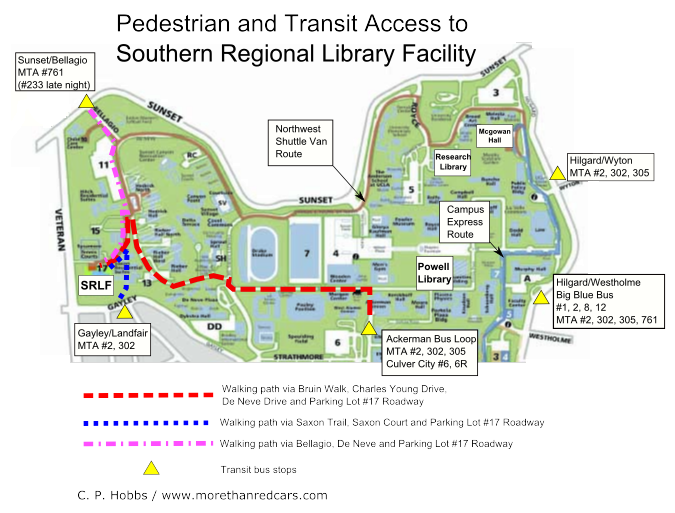
Transit and pedestrian access to the Southern Regional Library Facility

It is possible to walk to the SRLF. However, the area in and around the facility is hilly, and the walk takes me about 20-30 minutes from the center of campus

There are also a couple of transit choices. The free Campus Express bus, which normally runs between campus and Westwood, also has another route running between McGowan Hall and the SRLF. This “Northwest Shuttle Van” connects with the main Campus Express route at the McGowan Hall loop, or you can walk to/from the MTA bus stop at Hilgard and Wyton (MTA #2/302, #305). The disadvantage is that the shuttle van runs only from 11:30 am to 2 p.m; leaving you stranded if you wish to stay at the SRLF longer.

Another option is to walk along the “Saxon Trail” from the bus stop at Gayley and Landfair (MTA #2) onto campus. Although this trail has a bad reputation, that I really don’t want to get into here, the real danger is probably tripping and falling on the badly maintained trail…

There is no pedestrian access to the SRLF from Veteran Avenue. Period. Don’t ask.

Let your fingers do the walking

It’s probably easier to request SRLF items via the UCLA Library Catalog. Materials can be delivered to the on-campus library of your choice. Materials requested by 11 am will be delivered by 4 pm the same (business) day; otherwise, they will arrive by 4 pm the next day. The library will also send you an e-mail reminder, if you gave them an e-mail address when you applied for your card.

Interlibrary Loan

You can also obtain SRLF items by asking your local public, college or other library to borrow them for you. Fees and other conditions may apply.

References:

http://www.srlf.ucla.edu/ (official SRLF page)

http://www.youtube.com/watch?v=krbIAGFG47k

This video shows the process of using the catalog to request items. But a ten minute walk from the center of campus to SRLF? I doubt it!

http://infomaster76.blogspot.com/2009/02/southern-regional-library-facility.html (another good page describing the SRLF – with pictures of the closed stack areas. Interesting!)

Comments and corrections welcomed!

From Los Angeles to the Inland Empire: A History of RTD Line #496

It used to be a lot easier to get from Los Angeles to Riverside or San Bernardino than it is now.

RTD #496, and its predecessor #60 connected Los Angeles and the San Gabriel Valley with the Inland Empire. Just hop on the bus, and within a couple of hours, you’d be some sixty miles away. No transferring, no trouble.

Story of a long route
The history of these routes can be traced all the way back to the interurban “stage” buses of the early 1910s. Truston Clark ran a bus line from Los Angeles to San Bernardino and Redlands via Ontario, while the A.R.G. Bus Co. operated over a similar route to Riverside. These bus lines competed with the Pacific Electric route from Los Angeles to San Bernardino, although the rail line operated along a more northerly route.

In the early 1920s, O.R. Fuller’s Motor Transit took over the Clark and A.R.G. bus lines and operated them from a depot at Los Angeles and Sixth Streets, downtown. These buses used Valley Boulevard between Los Angeles and Pomona, making good time along the relatively lightly trafficked road.

Between 1929 and 1933, a series of mergers and acquisitions left Motor Transit under the control of Pacific Electric. In a cost saving move, PE began to replace certain passenger rail lines with bus service. As the Los Angeles-San Bernardino rail line was cut back in the 1940s, a new bus route running along Foothill Boulevard went into service. When PE numbered its bus lines, this complex of routes received several numbers before eventually being designated #60.

Taking it to the freeway
As the San Gabriel Valley developed, travel along Valley Boulevard became increasingly slower. However, the San Bernardino Freeway had opened in the early 1960s. In 1964, the #60 was rerouted to use the freeway. A new local route, #53, served Valley Bl. between Los Angeles and Pomona.

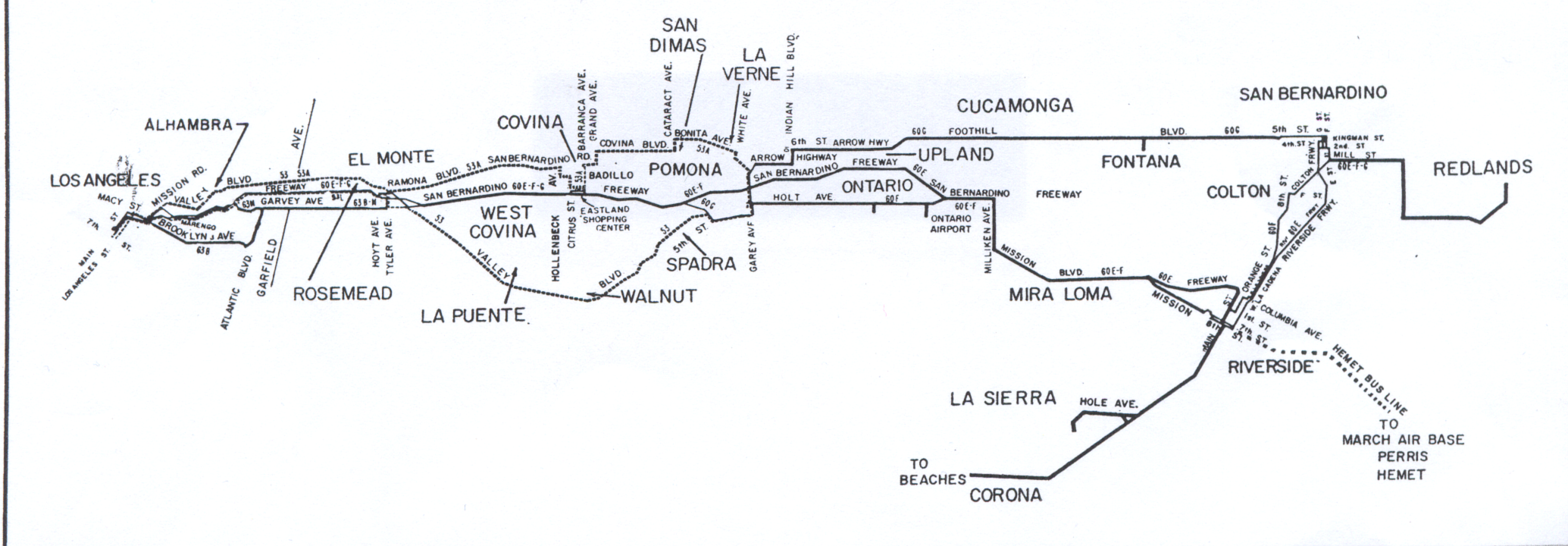
LAMTA #60 between Los Angeles and Riverside/San Bernardino

LAMTA #60 between Los Angeles and Riverside/San Bernardino

#60 ran express to Pomona; then it split into three routes. #60E continued to Riverside before veering north to San Bernardino via Colton. #60F was the express version of #60E; it spent more time on the freeway and made only limited stops. #60G left Pomona for Claremont, and then continued through the foothill communities of Upland, Fontana and Rialto to San Bernardino.

This service pattern operated until 1973. That year, the bus company, now known as the Southern California Rapid Transit District (RTD) asked the surrounding counties to help pay for the bus service. San Bernardino County refused, so RTD cut back the #60G to Upland. San Bernardino County replaced the Upland-San Bernardino portion of #60G with a new service, named “East Valley Transit.” (When Omnitrans came into being in 1976, this route became its #14.)

The birth of the #496

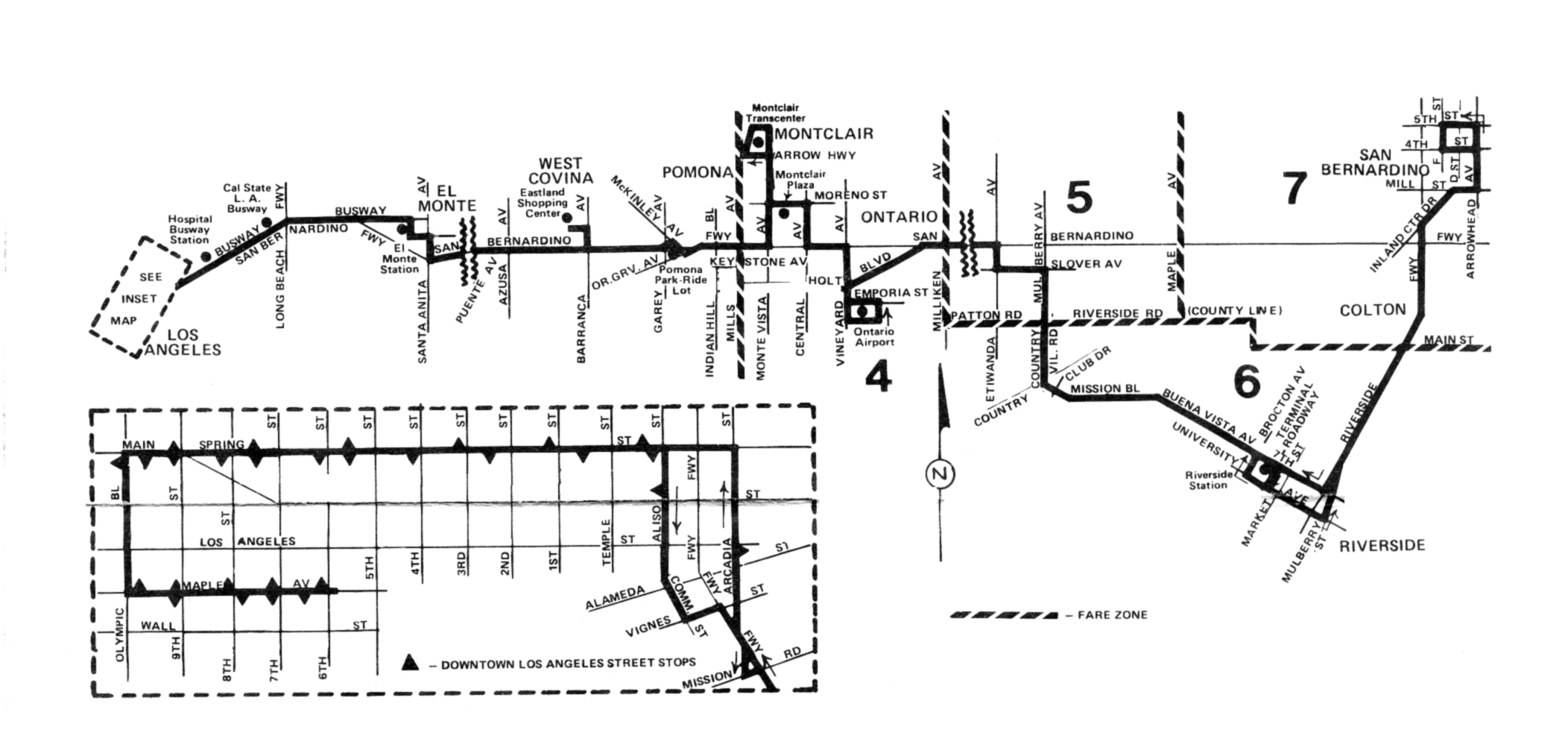
RTD Line #496

RTD Line #496, eff. April 10, 1988

Development continued throughout the San Gabriel and Pomona Valleys, and traffic increased to the point that RTD needed to reconfigure service again. In April 1976, RTD replaced the venerable #60 with two new lines. #480 would operate along the San Bernardino Freeway to Pomona, providing local stops along its route. #496 would operate along the freeway to Riverside and San Bernardino. Interestingly, while #496 would make stops in Los Angeles County cities (El Monte, West Covina, Pomona), it would only carry passengers destined to either Sa

n Bernardino or Riverside County. Los Angeles County-only passengers were usually told in no uncertain terms to take the #480, although an occasional sympathetic driver on a late night #496 might carry a passenger to Pomona Park-Ride after the last of the commuter buses had left Downtown LA for the evening.

For the next fourteen years, #496 made its rounds between Los Angeles and the Inland Empire, with only a few minor changes made to the route (most notably, service in downtown Pomona was dropped, and buses only stopped at the Pomona Park-Ride lot).

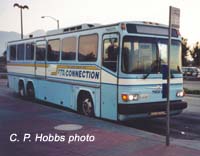
Inland Empire Connection bus. Charles P. Hobbs photo

Inland Empire Connection bus

The Inland Empire Connection
As the end of the 1980s approached, transit agencies started to consider contracting with private bus companies to provide service at a lower cost. (The private companies saved cost by paying drivers less than the public operators did). In Southern California, “Foothill Transit” and “Commuter Express,” both of which contracted with private operators, had both begun service in late 1987. These new bus operations attracted riders who had formerly shunned RTD buses.

In 1990, the transit agencies of Los Angeles, Riverside, and San Bernardino County decided to turn the #496 over to a private contractor. By August 20 of that year, the red-and-orange striped RTD buses had been replaced with the large blue coaches of the “Inland Empire Connection” (IEC), a joint effort of the three transit commissions. Since the operating cost of the service was about half that of RTD, there was enough money for a second route. This new route, dubbed #110, operated directly along the freeway between Montclair and San Bernardino; passengers destined to/from San Bernardino no longer had to swing through Riverside along the way. Jointly, IEC #110 and #496 provided service every 30 minutes between Los Angeles and Montclair. As with the RTD-operated #496, neither bus carried passengers entirely within Los Angeles County.

The beginning of the end
About three years later, the Los Angeles County transit agency, now known as the Los Angeles Metropolitan Transit Authority (MTA), began to rethink their involvement with IEC. Financial difficulties were causing the MTA to consider cutting service and raising fares. Also the Metrolink commuter rail system now carried commuters from San Bernardino and Riverside, causing IEC ridership to drop. By October 1993, MTA reduced funding for the IEC by half. This meant that the #110 and #496 would operate only every other trip west of Montclair to Los Angeles. In June 1994, MTA had cut all IEC funding and buses traveled only as far as Montclair. Passengers continuing further westward were forced to transfer to MTA, Foothill Transit, or Metrolink.

Next, Riverside County decided to pull support for the IEC, in favor of its local services.
In July 1995, the Riverside Transit Agency (RTA) started a new route, #49, over #496’s Mission Blvd route segment. between Riverside and Country Village (a large retirement home just north of the Pomona Freeway). #496 continued to run to Riverside, but during peak hours only via the freeway. Midday riders had to transfer between the #496 and #49 at Country Village. Occasionally the #496 would miss its connection with the last #49 leaving Country Village, stranding passengers.

Omnitrans  also decided to focus its resources on local transit. In January 1997, Omnitrans dropped funding for #496, and started a new route, #71 between Montclair and Country Village. (The bus agency decided to keep the #110, which operated entirely in San Bernardino County.) #71 was a local, surface-street route, taking longer than the freeway-express #496. That meant that not only did passengers still have to transfer, but their trips took longer.

Since #71 also ran weekdays only, the Riverside County Transportation Commission funded weekend-only service on #496 during 1997. As RTA seemed uncommitted to reinstating the #496, RCTC considered contracting with Foothill Transit to provide the service. But no agreement with Foothill could be reached. Meanwhile, all the cutbacks and other changes to #496 had caused ridership to plummet.

As the last #496 completed its trip in January 1998, RCTC chairman Bob Buster, contemplating the slow dismantling of what had been a productive bus route, remarked, “Los Angeles is like a modern-day Roman Empire, and Rome takes care of itself first and the provinces last.”

Express service between Riverside and San Bernardino (IEC #100) still operated, and passengers from Montclair could still use IEC #110 to San Bernardino, then transfer to #100 for the trip to Downtown Riverside. But this was still a longer trip than the former #496. #110 continued to operate, with a few stop changes (Ontario Airport was dropped, while new stops at Ontario Mills Mall, Kaiser Hospital Fontana and the Arrowhead Regional Medical Center were added), until July 2007. At that point, Omnitrans cut the Montclair-San Bernardino portion, leaving only the segment between Riverside and San Bernardino as the last remnant of what had been an extensive complex of bus routes operating between Los Angeles and the Inland Empire for over ninety years.

The return of 496…well, sort of
On September 2, 2003, RTA implemented four new long-distance express bus routes. These services, dubbed “Commuterlink,” were marketed toward business commuters. Commuterlink #204 operates between Riverside and Montclair on a route very similar to that of the old #496. In 2008, RTA extended #204 to the UC Riverside campus in an attempt to increase ridership.

Nowadays, if you can use #204, it is possible to get to Riverside easily. But #204 is strictly a peak-hour, weekday only service. Another alternative is Metrolink, but its reverse-commute trains are nowhere near as frequent as the old #110 and #496. Also, because the Riverside and (particularly) the San Bernardino stations are some distance from the downtown areas, prepare to walk or take a local bus to get to your destination.

Or, piece together local bus trips on Omnitrans and RTA, and hope the connections work out well…

References:

Bail, Eli, From Railway to Freeway: Pacific Electric and the Motor Coach.

“Expedited Service to Come on Lines 60 and 63 June 14.” MTA Emblem, May 1964, p. 9

Transit Advocate, July 1996, p. 3 (http://www.socata.net/advocate9607.pdf)

Pund, Ernest E. “Bus Route 496 rolls to LA for last time.” Riverside Press-Enterprise, January 29, 1998.

Welsh, John. “New buses to serve longer routes.” Riverside Press-Enterprise, June 26, 2003.

Western Transit (newsletter of the Western Transit Society), as appropriate

Bus schedules, maps, agency agendas, etc. as appropriate

Comments and corrections welcomed. Some details was necessarily left out or glossed over.

French Dips, Diesel Smoke, and Student Loans

Everyone knows that the best French Dip sandwiches in LA are at either Phillipe’s or Cole’s, right?

Maybe.

But there existed a third French Dip restaurant of little-known historical significance. It was located in a large building at the southeast corner of Figueroa and Santa Barbara (now Martin Luther King), just south of Downtown.

Probably the first time I even saw the term “French Dip” was when we drove by that building in the early 1970s.   (I still wasn’t sure what a French Dip was back then.  Something ladies did with their hair? It could have been a beauty salon for all I knew 🙂 )

Of course, a lot more than roast beef au jus was going on in this building. This was also the location of the National Technical Schools, at one time, one of the largest trade schools in the U.S.

Vrena Bender Rosenkrantz founded the school, which was originally named “National School of Engineering,” in 1905. Back then, automobiles were very uncommon and regarded with suspicion. At best, they were considered toys for the eccentric. And they certainly were not considered part of a woman’s domain back in those days either. But she saw the future potential of the automobile and decided to open up a school anyway.

Her first class, in a small building just west of Downtown, had only three students. Tuition was twenty-five dollars.

Over the next few years, however, the number of automobiles grew dramatically, and more and more students came to the school to learn how to repair their cars. As Vrena added instructors and programs, more space was needed. The school moved at least three times in Downtown Los Angeles. Finally, Vrena and her husband Joseph, who had taken over management of the school in 1920, purchased land at Figueroa and Santa Barbara Avenues and built a new building to house the ever-expanding school.
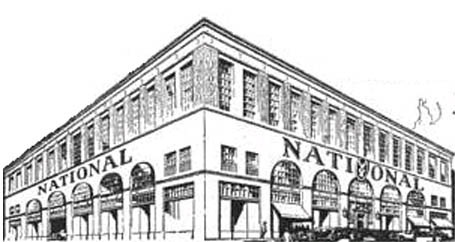
The new building opened in April 1923.  At the time, this three-story edifice was the largest building west of Kansas City. It was designed and built by Meyer and Holler, a firm famous for many other notable buildings in Southern Callifornia, including the Grauman’s Chinese and Egyptian Theaters.  The outside of the Italian-styled building featured several arches. Some of the building’s street frontage was rented out to shops, including the French Dip restaurant I mentioned earlier.

For the students, there were classrooms, laboratories, workshops, dormitories, a library and a gymnasium. It also had a public garage, where customers could have their cars repaired by students.  Over 200 students could receive instruction at one time.

The school advertised heavily in technical magazines such as Popular Mechanics and Popular Science. Prospective students needed little prodding to, as one ad read, “come to Los Angeles … where wintertime is like a glorious summer day.”

The automotive school also offered correspondence courses to students across the country and all over the world.  Some of the correspondence courses were offered in Spanish and the Rosenkranzes opened a campus in Mexico City. There were also plans for a new campus along Exposition Boulevard between La Brea and Crenshaw. However, school officials decided to expand the Figueroa Blvd. campus instead.

As technology advanced, the Automotive School added programs in aviation, radio repair, and radio broadcasting. When Diesel engines became practical in the mid-1930’s, the school had to expand rapidly to accommodate the influx of students interested in learning about these engines.

During World War II, the school trained hundreds of soldiers as radio technicians, electricians, and automobile mechanics. In late 1942, the school and its officials were indicted in Federal court for trying to defraud the government; after a three-day trial, the officials were acquitted of the charges because of lack of evidence of any wrongdoing.

After the war ended, enrollment swelled as returning soldiers used their G.I. Bill benefits to pay for education. As the post-war economy regained its consumer focus, there was more demand for automobiles—and people to repair them. Television was another growing post-war industry, and the school added programs in television repair. Classes in home appliance repair, and heating/ventilation/air conditioning, were also implemented to meet the need for repairmen.

In addition to the school, the Rosenkranzes participated in many charitable pursuits, both Jewish and secular. Joseph was a founding director of the Los Angeles Sanitarium in Duarte. (This institution became the City of Hope in 1949.) A few years before his death in 1948, he wrote several motivational books. Vrena was a longtime supporter of the California Home for the Aged in Reseda (now known as the Los Angeles Jewish Home). The Rosenkranzes had two sons: Louis became a director of the Los Angeles campus, while Samuel worked for the school in Mexico City.

In late 1959, the school changed its name to “National Technical Schools (NTS).” Ownership and control of the institution passed to its employees. Over the next three decades, NTS became increasingly dependent, on government funding. Soldiers returning from Korea and Vietnam brought in more G.I bill money; other students used federal and/or state financial aid to pay the tuition. The high-tech 1980s brought new courses in computer programming and repair and even robotics.

An Encino-based company, United Education and Software (UES) bought NTS in late 1985. UES already operated twelve other trade schools in California under the “Pacific Coast College” name. Initially, UES, which had been struggling, got a financial boost from the NTS acquisition. Unfortunately, things did not go well for either NTS or UES for long.

The US Department of Education audited NTS’ programs during 1987 and 1988, and found that one of its courses was too short to meet federal standards. The school was also sued by several students and the state Attorney General, accusing it of misrepresenting course content, job placement, and tuition costs, admitting academically unprepared students, and not properly refunding student loan money to students who had dropped out. NTS was temporarily barred from accepting any government financial aid. By December 1989, UES had filed for bankruptcy. NTS and several of the other UES campuses shut down.

The ornate, Italian-styled building remained until it was demolished in 1998. Today, a Chevron station and a McDonalds restaurant now occupy the site of what had been.

And no, they don’t serve French Dips.

Sources (roughly in order of appearance):

Los Angeles City Directories, 1915, 1918, 1922, 1923, 1929

“School for Auto Seen in Mexico.” Los Angeles Times, May 8, 1927

“Local School Has New Home.” Los Angeles Times, Dec 10, 1922

“National Automotive School Celebrates Formal Opening of New Three Story Building.” Los Angeles Times, April 6, 1923

http://en.wikipedia.org/wiki/Meyer_&_Holler [accessed May 12, 2010]

“School Now to Occupy More Room.” Los Angeles Times, May 5, 1935

“School Quarters Being Improved.” Los Angeles Times, May 26, 1935

“New Diesel Class Ready.” Los Angeles Times, Aug 25, 1935

“Diesel Engines Stir Interest.” Los Angeles Times, Oct 6, 1935

“Engineering School for Southwest Area.” Los Angeles Times, May 24, 1936

“Lynn Named Radio Coach.” Los Angeles Times, Jan 26, 1936

“Auto Schools Now Occupying New Addition.” Los Angeles Times, Jul 19, 1936

“Diesel Training Gains In Demand.” Los Angeles Times, Nov 8, 1936

“Army Technical Men Graduate.” Los Angeles Times, Sep 25, 1942

“Schools Training Radio Men for Army Indicted.” Los Angeles Times, Oct 29, 1942
”Trio Accused of Fraud Attempt Found Innocent.” Los Angeles Times, Apr 16, 1943

“White Plague Their Battle.” Los Angeles Times, Feb 16, 1914

“Re-elected.” Los Angeles Times, Aug 2, 1935

Motivational Books by Joseph Rosenkranz

“Trade Schools Executive Dies.” Los Angeles Times, Jan 27, 1948

“Mrs. Vrena Rosenkranz Services Set.” Los Angeles Times, May 1, 1963

Advertisements in Popular Mechanics, Popular Science, Popular Electronics ,etc. – just about every issue of these magazines had an ad for this school. In fact, just about any magazine with a predominately male readership would have these ads.

“Two trade-school companies agreed to combine.” Los Angeles Times, Sep 20, 1985

“Computer Marketing Plans Fail to Make Grade.” Los Angeles Times, Oct 1, 1985

“United Education Reports 142% Rise in 2nd Quarter.” Los Angeles Times, Aug 26, 1986

Singh, Umendra. “Correspondence Course in Computers Draws Fire.” Seattle Times, Dec 8, 1987

Apodaca, Patrice. “U.S. Halts Loans for Trade School Run by UES.” Los Angeles Times, Oct 17, 1989

“Court Lifts UES Exclusion From Loan Program.” Los Angeles Times, Oct 24, 1989

“Suit-Troubled Trade School Poorly Run, Critics Charge.” Los Angeles Times, Nov 28, 1989.

Apodaca, Patrice. “Trade School Operator Files for Protection.” Los Angeles Times, Dec 6, 1989

Apodaca, Patrice. “2 Years of Problems Pushed United Education into Reorganization.” Los Angeles Times, Dec 13, 1989